The Signal Hunters: How to Read What Mainstream Media Isn't Saying Out Loud
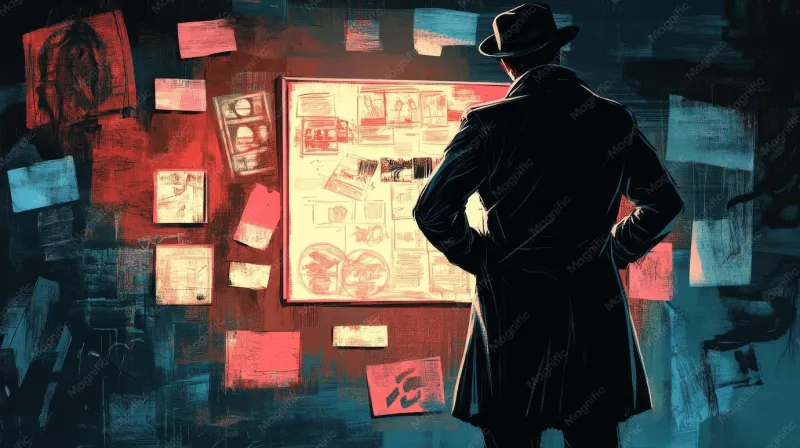
Photo: person analyzing film screen detective board symbols media, via img.freepik.com
Pop open any major film's subreddit the week after release and you'll find two very different conversations happening simultaneously. One is about the movie. The other is about everything around the movie — the frame choices, the color grading, the background props, the casting decisions, the release date, the poster typography. For a certain type of viewer, the official text is almost secondary. The real content is in the margins.
Welcome to signal hunting — the practice of treating mainstream media not as a finished product to be consumed, but as a layered transmission to be decoded.
A Long History of Reading Between the Lines
This isn't new behavior. Humans have always looked for hidden meaning in public communication. Religious iconography, political propaganda, advertising psychology — the idea that images and stories carry secondary messages beneath their surface is basically foundational to how we understand media at all.
What's changed is the infrastructure. The internet — and specifically the weird, obsessive, collaborative corners of it — has turned individual close-reading into a collective sport. ARG (alternate reality game) communities have spent years training themselves to find intentional puzzles embedded in marketing campaigns, websites, and video content. When HBO launched Westworld, the show's marketing team seeded elaborate puzzles across multiple platforms that fans dissected in real time. When Beyoncé dropped Lemonade, cultural analysts, Twitter users, and academics were simultaneously unpacking its visual references within hours.
The tools and habits developed in those spaces have bled outward. Now signal hunting shows up everywhere — in film theory YouTube channels with millions of subscribers, in TikTok accounts dedicated to "things you missed" in popular shows, in Discord servers where users catalog every background detail of a new streaming series.
The Intentional and the Accidental
Here's where it gets genuinely interesting, and genuinely complicated. Not all signals are planted. Some are.
Filmmakers, advertisers, and creative directors absolutely do embed intentional Easter eggs, callbacks, and layered references into their work. It's a craft tradition. Directors like Paul Thomas Anderson and Jordan Peele have spoken openly about the density of their visual languages. Ad agencies design campaigns with multiple interpretive layers, knowing that different audience segments will catch different things. Some of this is artistic integrity. Some of it is engagement strategy — giving super-fans something to find keeps them invested and talking.
But a lot of what gets decoded as intentional signal is actually something else: coincidence, pattern-matching, and the brain's spectacular ability to find meaning in noise. Psychologists call this apophenia — the tendency to perceive connections between unrelated things. It's the same cognitive function that makes us see faces in clouds or hear words in white noise. It's not a flaw, exactly. It's a feature of human perception that occasionally runs too hot.
The challenge for signal hunters — and the thing that separates the genuinely skilled media readers from the conspiracy spiral — is developing a feel for which is which.
A Field Guide to Responsible Decoding
So what does good signal hunting actually look like? Here are a few principles that the best practitioners tend to work with.
Authorial intent is traceable. If a director consistently uses a specific color palette to signal a character's emotional state across multiple films, that's a documented pattern you can verify. If a single frame in one movie kind of looks like a symbol from a different movie made by a different studio fifteen years earlier, you're probably building a cathedral out of coincidence.
Context beats isolated details. A background prop that seems significant is more meaningful when it recurs, when it connects to the story's themes, or when the creative team has a documented history of hiding things. Out-of-context screenshots are the enemy of honest interpretation.
The best Easter eggs reward, not replace. Genuine embedded signals tend to add to the experience — they deepen a theme, reward a careful viewer, or connect a universe. When "decoding" requires you to ignore the actual text of what you're watching in favor of an external theory, that's a sign you've left media analysis and entered something else.
Distinguish between "I found something" and "I can prove something." The most intellectually honest signal hunters present their readings as interpretations, not revelations. There's a huge difference between "this image composition echoes classic propaganda aesthetics, which is interesting given the film's themes" and "this proves the studio is sending coded messages to a secret society."
Why This Stuff Actually Matters
Beyond the fun of the detective work — and it is genuinely fun — signal hunting as a practice has real cultural value. It's a form of active media literacy at a moment when passive consumption is the default.
When viewers start asking why a show is lit a certain way, or who decided that a character would wear that specific color in that specific scene, they're engaging with media as a constructed artifact rather than a transparent window. That's a more sophisticated and ultimately more empowering relationship with the content that fills our screens.
The ARG communities that trained themselves on elaborate marketing puzzles developed skills — collaborative problem-solving, source verification, lateral thinking — that transfer directly to navigating an information environment full of genuine deception. The habit of asking "what is this actually trying to tell me, and why" is useful everywhere.
The Line You Don't Want to Cross
None of this is an endorsement of the darker corners of signal hunting culture, where media analysis bleeds into conspiracy thinking and ordinary entertainment becomes "proof" of coordinated malevolence. That territory is real, it's seductive, and it causes genuine harm.
The static is always going to be there. The signal hunters who do this well are the ones who've learned to love the hunt without needing the answer to be something sinister. Sometimes the breadcrumb leads to a beautiful hidden reference. Sometimes it leads nowhere. Both outcomes are valid.
The point was never to find a conspiracy. The point was to learn how to look.